Property Lines for Fence Installation in Illinois: The Ultimate Guide to Legal Boundaries, Setbacks, Permits & Secure Perimeter Fencing
Installing a new fence involves the full responsibility of the property owner to determine exact property lines. If you aren't installing a fence encompassing the entire perimeter, and relying on neighbor fences or boundaries, you could run into issues.

If you're planning a fence installation in Illinois, understanding property lines for fence installation in Illinois is the single most important step to avoid costly disputes, forced removals, or neighbor conflicts. Whether you're in Chicago suburbs, downstate rural areas, or anywhere in between, Illinois fence laws and local ordinances make one thing crystal clear: your new fence must stay entirely within your own property boundaries.
This comprehensive guide covers everything homeowners need to know about Illinois property boundaries for fences—from state and local laws to how professional installers handle real-world challenges. We'll explain exactly why fences must be installed strictly inside your lines, the limited accommodations some companies offer, and why only a full perimeter fence on your own property guarantees a secure enclosure. By the end, you'll have the knowledge to protect your investment and your peace of mind.

Why Property Lines Matter More Than Ever for Fence Projects in Illinois
Illinois homeowners install thousands of new fences every year—for privacy, security, pet containment, and curb appeal. But property line mistakes remain one of the top reasons for neighbor disputes and legal headaches. A fence even a few inches over the line counts as encroachment under Illinois law, potentially forcing you to tear it down at your own expense.
The Illinois Fence Act (765 ILCS 130) provides baseline rules, primarily for rural and agricultural "division fences" in counties under 1 million population (excluding Cook County). It requires adjoining landowners to share costs of boundary fences in just proportion when one owner wants to enclose land. However, most residential fence projects fall under local municipal zoning codes and building ordinances, not the state Fence Act.
Key takeaway: A fence does not define your property line. Only a recorded plat of survey or professional land survey does. Guessing based on old fences, sidewalks, or landscaping is a recipe for trouble.
Illinois Fence Laws: State Rules, Local Ordinances & Setbacks
Illinois does not have a uniform statewide setback requirement for fences. Most cities and villages allow fences directly on (or abutting) the property line, but many impose small setbacks—often 6"–1 foot from the lot line, especially in front yards or along streets. Corner lots face stricter visibility rules to protect traffic sightlines.
Common local requirements include:
- Height limits: Typically 6–8 feet in rear/side yards; 3–4 feet maximum in front yards.
- Permits: Required in nearly every Illinois municipality (Schaumburg, Naperville, Huntley, Mundelein, etc.). You’ll often need to submit a plat of survey showing exact fence location (76 Fence handles all of this for you).
- Materials & styles: No barbed wire or electrified fences in most residential zones.
- Easements & utilities: Fences cannot block recorded easements or utility rights-of-way. A gate or removable panel must be installed if blocking in utility boxes (if the boxes are on your property).
Always check your specific city or village website or call the building department. Unincorporated areas fall under county rules (e.g., Cook County requires 2 feet from public right-of-way in some zones).

How to Accurately Determine Your Property Boundaries Before Installation
The homeowner bears sole responsibility for knowing exact property lines. Professional fence companies verify visible markers as a courtesy, but they cannot—and will not—guarantee boundaries without a survey.
Reliable methods (in order of accuracy):
- Hire a licensed Illinois Professional Land Surveyor (PLS): This is the gold standard. Surveyors locate and monument the official iron pins, pipes, or stakes (usually ½" or ¾" diameter) at your property corners.
- Review your plat of survey: Most Illinois subdivisions have a recorded plat on file with the county recorder. It shows precise measurements from the street or benchmarks.
- County GIS mapping tools: Helpful for a rough idea (Cook County Property Info Portal, DuPage County GIS, etc.), but not legally sufficient for fence placement.
- Visible markers: Look for ½"–¾" iron pipes or stakes in 2–4 corners. These are often buried just below grade. Never rely on existing fences, hedges, or retaining walls.
Pro tip: Schedule your survey before requesting fence quotes. It prevents delays and ensures your installer can plan posts and panels to fit perfectly inside your lines.
Common Property Line Mistakes That Lead to Fence Disputes in Illinois
- Assuming an old neighbor fence marks the true line.
- Building to match a neighbor’s offset fence without verifying your own boundaries.
- Ignoring corner-lot visibility triangles or utility easements.
- Relying on DIY measurements or phone apps.
Disputes are civil matters between neighbors—cities rarely get involved. Resolution often requires a new survey, boundary agreement, or court action (quiet title or ejectment). Prevention is far cheaper.

Fences Must Be Installed Strictly Within Your Property Boundaries: Critical Installation Rules in Illinois
Half of successful fence projects in Illinois hinge on this non-negotiable rule: every post, panel, and gate must sit entirely within your own property lines. Illinois law and local codes prohibit any permanent encroachment onto neighboring land. Professional installers follow strict protocols to protect you—and themselves—from liability.
Here’s exactly how responsible fence companies approach property line installations across Illinois:
- No permanent posts beyond your property lines: Any section of fence that must extend slightly past your surveyed line to meet a neighbor’s existing structure (or to close a gap) cannot include permanent posts set in concrete or driven deep into the ground on the neighbor’s side. Permanent posts create a legal claim of encroachment and expose both you and the installer to disputes or removal orders.
- Maximum 1–2 foot unsupported extension only: The only allowable accommodation is a short, unsupported cantilever or “floating” extension of the fence panel itself—never more than 1–2 feet beyond the last legal post on your property. This section has no ground contact or permanent anchoring on the neighbor’s side. It is purely a visual and functional courtesy to reduce gaps, not a structural or permanent solution.
- This extension is an accommodation only—not the fence company’s responsibility: The unsupported 1–2 foot section is offered solely as a customer-requested convenience when a full perimeter isn’t being purchased. The fence company assumes zero responsibility for its long-term stability, maintenance, or any future neighbor complaints. Weather, pets, or children pushing on it can cause it to sag or fail over time because it lacks proper post support. This is merely an accommodation and may lack aesthetic (it won't look pretty).
- The only way to guarantee a secure full-perimeter enclosure is a complete fence on your own property: Using a neighbor’s existing fence, a retaining wall, or any other boundary feature as part of your enclosure is not the responsibility of the installing fence company. These neighboring structures belong to someone else and may be removed, replaced, or altered without notice. Relying on them leaves gaps, security weaknesses, and potential liability if an animal or child escapes.
- No connections or accommodations to neighbor’s fences allowed: Professional installers will never attach, connect, or modify your fence to tie into a neighbor’s fence. Doing so creates shared ownership questions, maintenance disputes, and potential damage claims. Every panel and post of your new fence must stand alone on your surveyed property. An attachment can only be done with permission from the neighbor.
- Property marker verification is a courtesy—boundary determination is 100% the owner’s duty: Reputable companies will look for and verify existing ½" or ¾" iron pipes or stakes in the visible corners as part of the site visit. However, this is not a legal survey. It is the homeowner’s sole responsibility to confirm exact boundaries before installation day. The best ways to do this are:
- Commissioning a new or updated plat of survey from a licensed Illinois surveyor.
- Providing your recorded plat of survey with clear measurements.
If markers are missing, damaged, or unclear, stop the project and order a survey. No professional fence company will guarantee that posts will remain inside your lines.
- If your neighbor’s fence sits far inside their own property: Many older fences were built 1–3 feet inside the true line for maintenance access or to avoid disputes. If you are only purchasing a partial fence (e.g., just one side of the back yard), the installing company cannot and will not extend your fence across the open gap to connect to the distant neighbor fence. Closing off your entire perimeter requires purchasing and installing a full perimeter fence built entirely on your own property. Partial installations leave intentional gaps by design—those are your responsibility to manage or close later with your own fencing.
These rules exist to keep every Illinois fence project legal, defensible, and built to last. Cutting corners on property lines is the fastest way to turn a backyard upgrade into a years-long headache.
Permitting, Local Variations & Working With Professional Installers
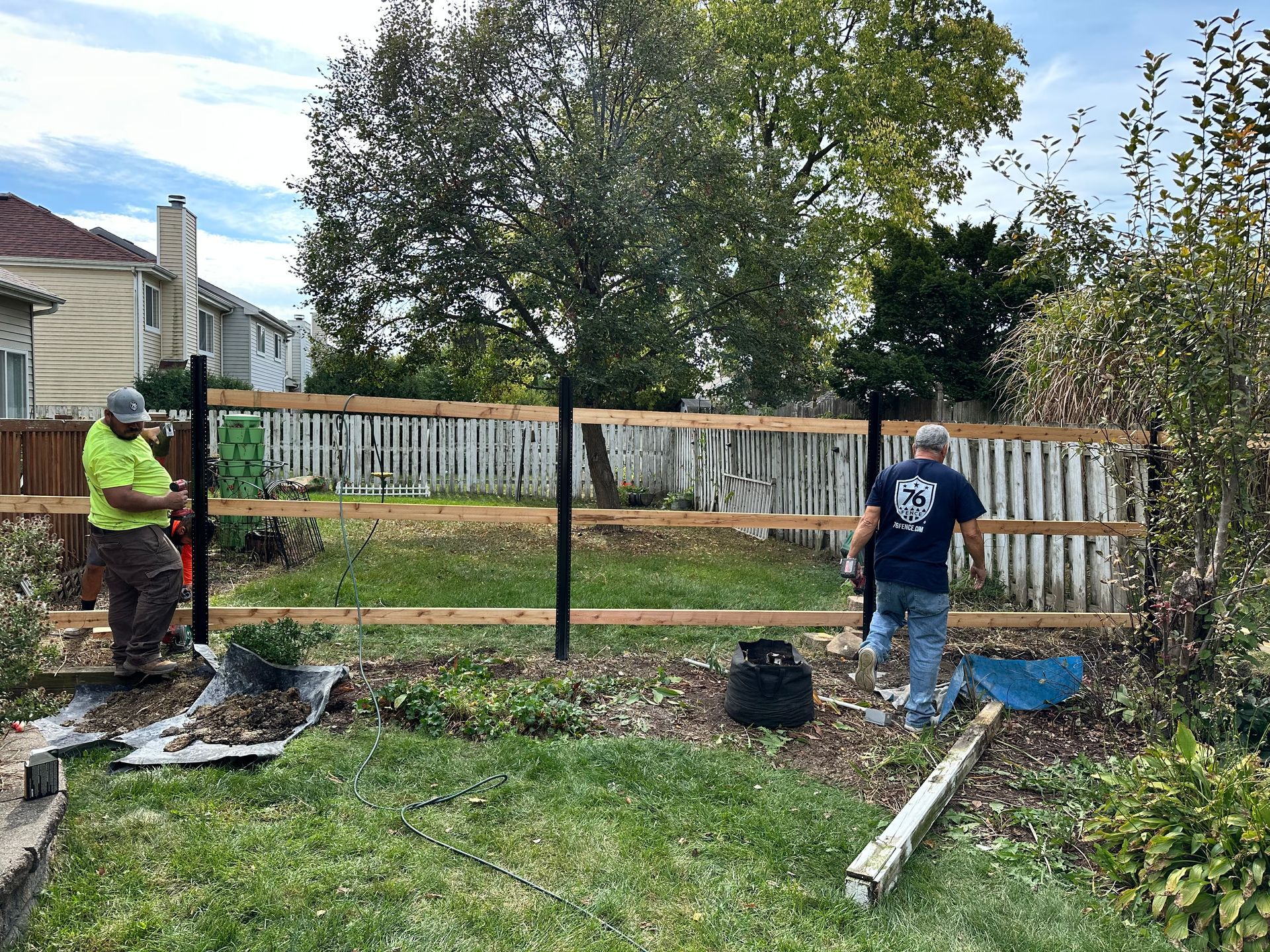
Once boundaries are confirmed, your installer will handle permit applications in most cases. They’ll also call JULIE (811) for utility locates before digging. Expect the process to take 1–4 weeks depending on your municipality.
In high-density suburbs (Naperville, Schaumburg, Buffalo Grove, etc.), inspectors may require the fence company to show the plat of survey on-site. Rural or unincorporated areas often have fewer restrictions but still require adherence to the Illinois Fence Act for division fences.
Best Practices for a Trouble-Free Fence Installation in Illinois
- Get the survey first.
- Choose a full-perimeter design whenever possible for maximum security and privacy.
- Discuss any needed 1–2 foot accommodations upfront so expectations are clear.
- Maintain open communication with neighbors—courtesy goes a long way.
- Document everything: photos of markers, signed contracts, and the final survey.
Frequently Asked Questions About Property Lines & Fence Installation in Illinois
Can I build my fence right on the property line?
In most Illinois municipalities, yes—provided it doesn’t cross the line and meets local setbacks (if any). The fence must be installed within your property, not on it or over it.
What if my neighbor’s fence is already on my line?
That fence may be an encroachment. A survey is required before you build.
Does the fence company survey my property?
No. They verify visible markers only. You must provide legal proof of boundaries.
What happens if I install a fence over the line?
You risk a neighbor lawsuit, forced removal, and paying their legal fees.
Is a full perimeter fence more expensive?
Yes, but it’s the only way to achieve a truly secure, gap-free enclosure that you control 100%.
Protect Your Property—Start With the Right Boundaries
Installing a fence in Illinois is a major investment in your home’s security, privacy, and value. By treating property lines for fence installation in Illinois as the foundation of the entire project, you avoid 99% of the problems that plague DIY or low-bid installations.
At professional fence companies across the state, the policy is simple: we build every fence entirely within your verified property boundaries. Short unsupported extensions are offered only as a limited courtesy when requested, never as a substitute for proper perimeter fencing. Your boundaries, your survey, your responsibility—our expertise in building strong, code-compliant fences that last for decades.
Ready to secure your property the right way? Contact a licensed, experienced Illinois fence installer today. Provide your plat of survey or schedule a professional survey, and get a free quote for a full-perimeter fence built exactly where it belongs—inside your lines, built to last.
Your neighbors (and your future self) will thank you.
How 76 Fence Can Help Determine Property Lines
Need help to determine your property lines? 76 Fence will handle the following on your behalf:
- Review your plat of survey
- Conduct an onsite visit to help you locate property stakes/pipes
- Run a string line prior to fence installation (this is done after deposit prior to installation)
- Discuss potential obstacles/issues with your intended fence placement
- Answer any questions you may have!
Fence Installation Blog




How to Upgrade Your Chain Link Fence with Privacy Slats: Benefits, Styles & Installation in Illinois